

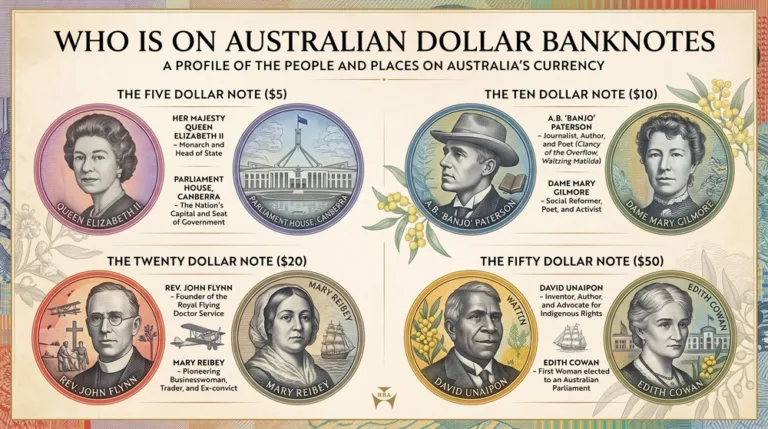
Do You Know Who Is on Australian Dollar Bills?
When you exchange currency and hold Australian money in your hands, you immediately notice a few things. First, the money is made of a smooth plastic material called polymer. Second, the bills feature bright colors and a clear window running top to bottom. But beyond the modern security features, people often ask: who is on Australian dollar bills?
The Reserve Bank of Australia (RBA) designs its currency to honor people who made major contributions to the country. The faces on AUD belong to poets, inventors, social reformers, business pioneers, and military leaders. If you are preparing for a trip or simply curious about the money you just exchanged at SILKROAD Currency Exchange, we put together this complete guide to explain who is on AUD banknotes.
The $5 Banknote: Queen Elizabeth II and Parliament House
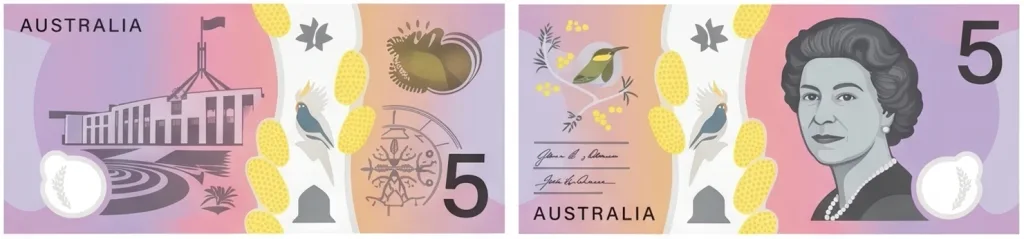
The $5 bill is the lowest denomination of paper—or rather, polymer—money in Australia. The note features a distinct purple and mauve color palette. As part of the Next Generation Banknote (NGB) program rolled out in 2016, the $5 note includes tactile bumps on the edges to help vision-impaired users identify it, along with images of the Prickly Moses wattle and the Eastern Spinebill bird.
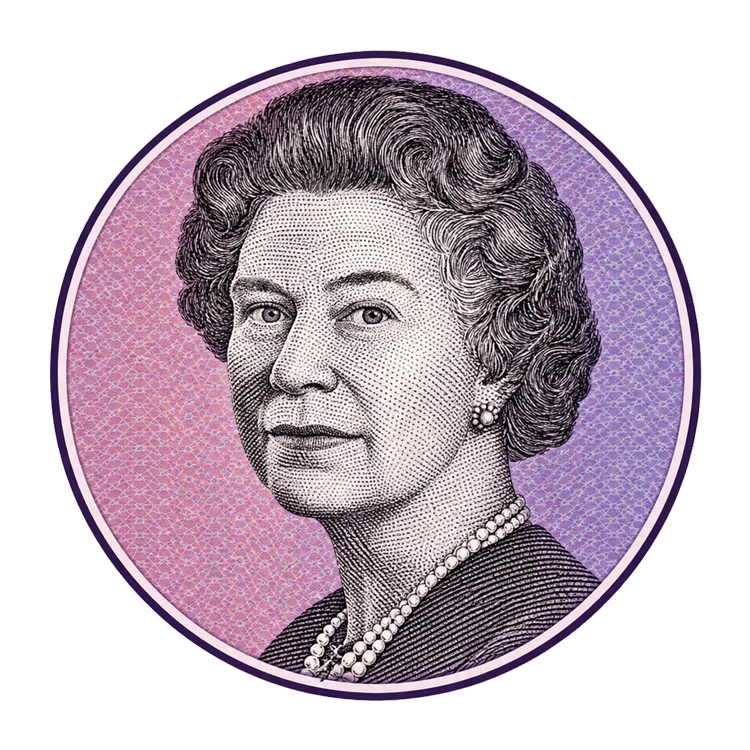
Front Side: Queen Elizabeth II
The front of the $5 note features Queen Elizabeth II. Her portrait is based on a photograph taken in 1984 by John Lawrence. Australia is a constitutional monarchy, and the British sovereign serves as the head of state, which is why she appears on the currency. Following the Queen’s passing, the RBA announced in early 2023 that King Charles III will not replace her on the $5 note. Instead, future printings of the $5 bill will feature a new design honoring the culture and history of First Australians. However, the current notes featuring Queen Elizabeth II remain legal tender and will stay in circulation for years to come.
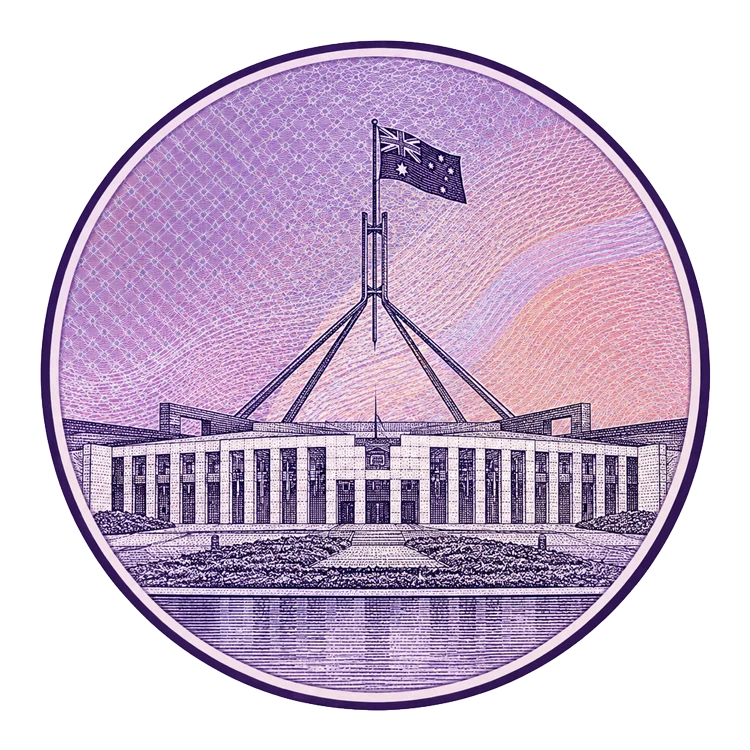
Rear Side: Australian Parliament House
Turn the $5 note over, and you see the Australian Parliament House located in Canberra. The design shows both the modern New Parliament House, recognizable by its massive flagpole, and the Old Parliament House. The background includes details of the mosaic forecourt designed by Aboriginal artist Michael Nelson Jagamara, representing the democratic process of the nation.
The $10 Banknote: AB ‘Banjo’ Paterson and Dame Mary Gilmore
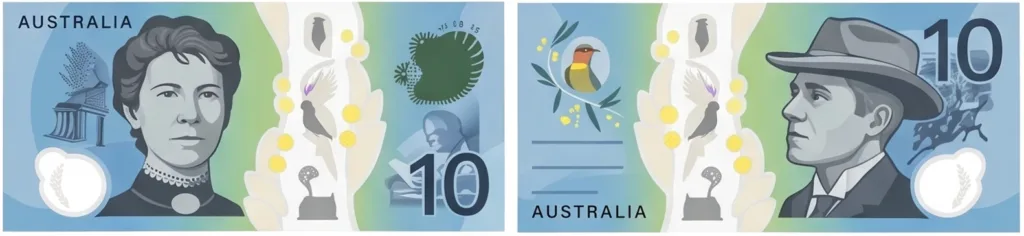
Australia’s $10 note is bright blue. The 2017 redesign added security elements like a 3D pen nib that appears to move as you tilt the bill, alongside illustrations of the Bramble Wattle and the Sulphur-crested Cockatoo. Both faces on Australian dollar bills of this denomination belong to legendary writers.
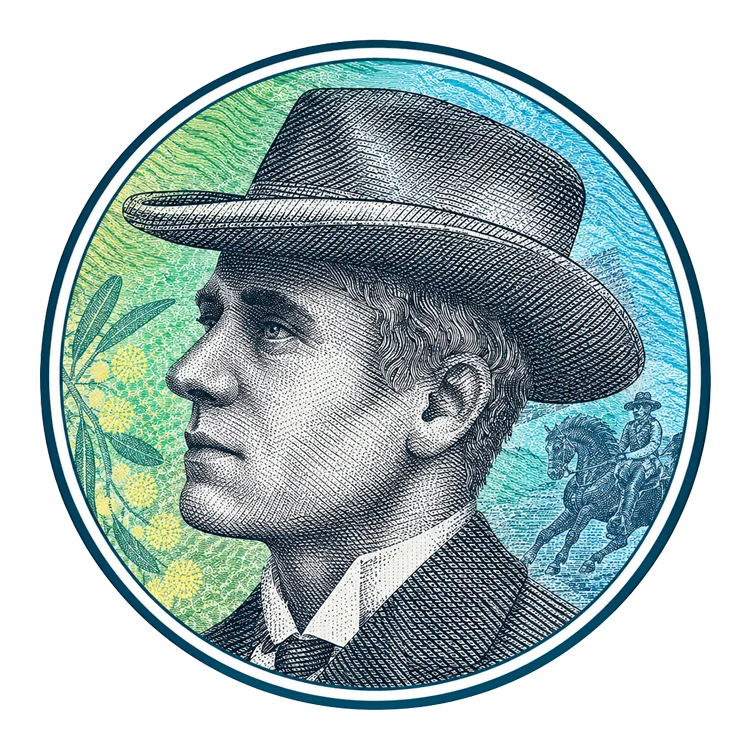
Front Side: AB ‘Banjo’ Paterson
Andrew Barton “Banjo” Paterson (1864–1941) was a famous Australian bush poet, journalist, and author. He wrote some of the country’s most recognized folk poetry, including “The Man from Snowy River” and the unofficial national anthem, “Waltzing Matilda.” Paterson also worked as a war correspondent during the Boer War and served as an ambulance driver in France during World War I. If you look closely at the $10 note with a magnifying glass, you can see micro-printed lines from his poem “The Man from Snowy River” surrounding his portrait.
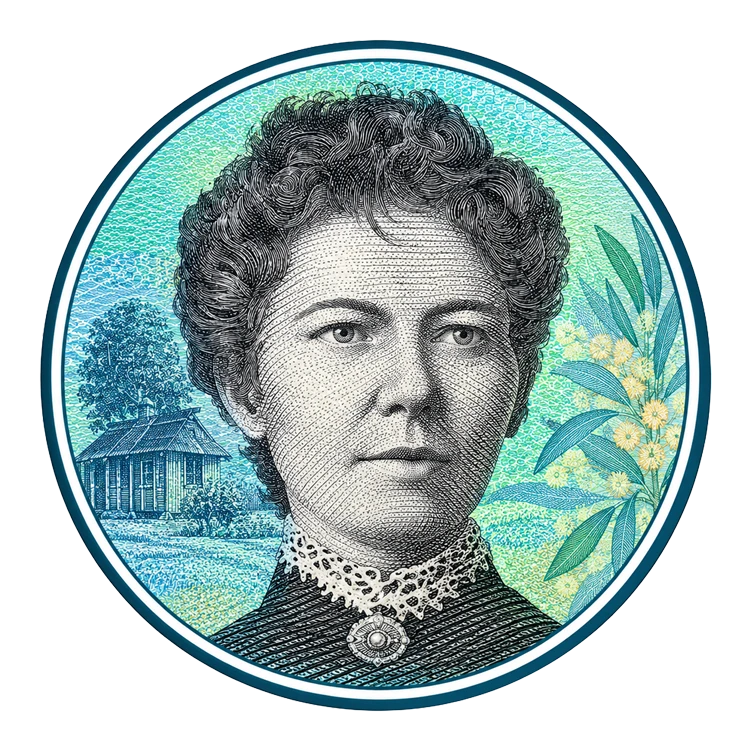
Rear Side: Dame Mary Gilmore
Dame Mary Gilmore (1865–1962) graces the reverse side of the $10 bill. She was a poet, journalist, and passionate campaigner for the disadvantaged. She used her writing to fight for women’s voting rights, improved working conditions, and the protection of Indigenous Australians. The note features micro-printed text from her patriotic poem “No Foe Shall Gather Our Harvest”. The portrait of Gilmore on the currency is based on a photograph taken when she was in her early twenties.
The $20 Banknote: Mary Reibey and Reverend John Flynn
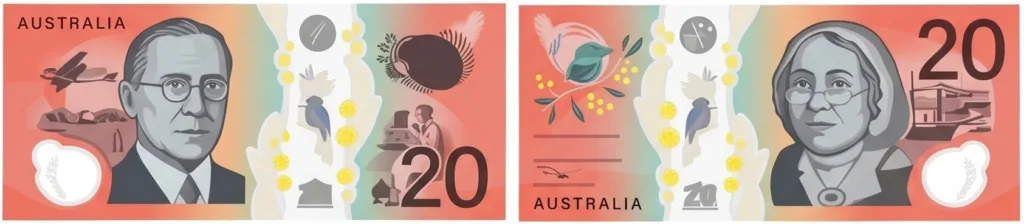
The red and orange $20 note, updated in 2019, pays tribute to an early business tycoon and a pioneer of outback medical care. The modern bill includes the Acacia buxifolia (Box-leaf Wattle) and the Laughing Kookaburra.
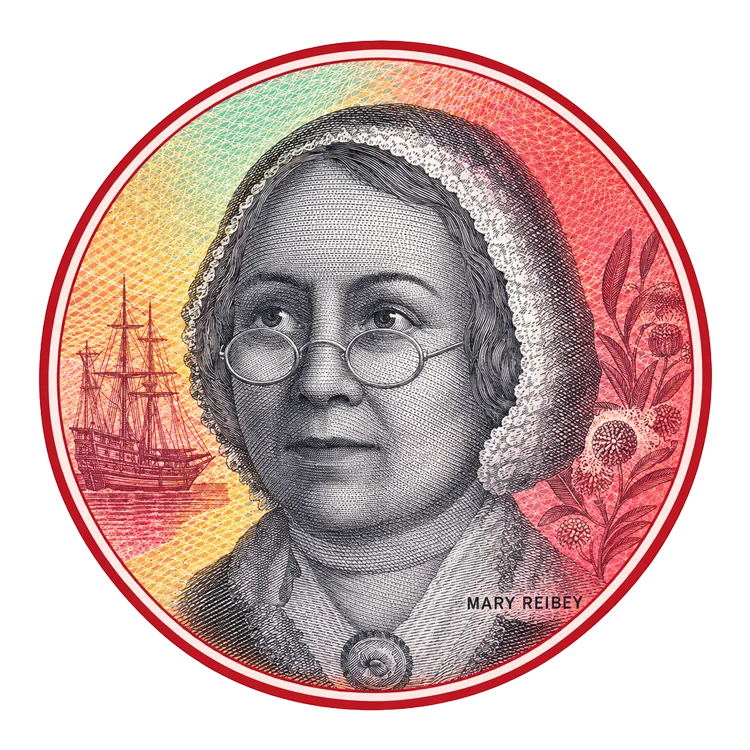
Front Side: Mary Reibey
Mary Reibey (1777–1855) has one of the most remarkable life stories of anyone on Australian currency. Born in England, she was arrested at age 13 for stealing a horse while dressed as a boy. She was convicted and transported to the penal colony of Sydney. After serving her time, she married a junior ship’s officer, Thomas Reibey. Together they started a business, and after his death, she took full control. She expanded her interests into shipping, real estate, and trading, eventually becoming one of the wealthiest and most successful businesswomen in colonial Australia. The banknote shows a miniature portrait of her, alongside images of a traditional sailing ship and a compass.
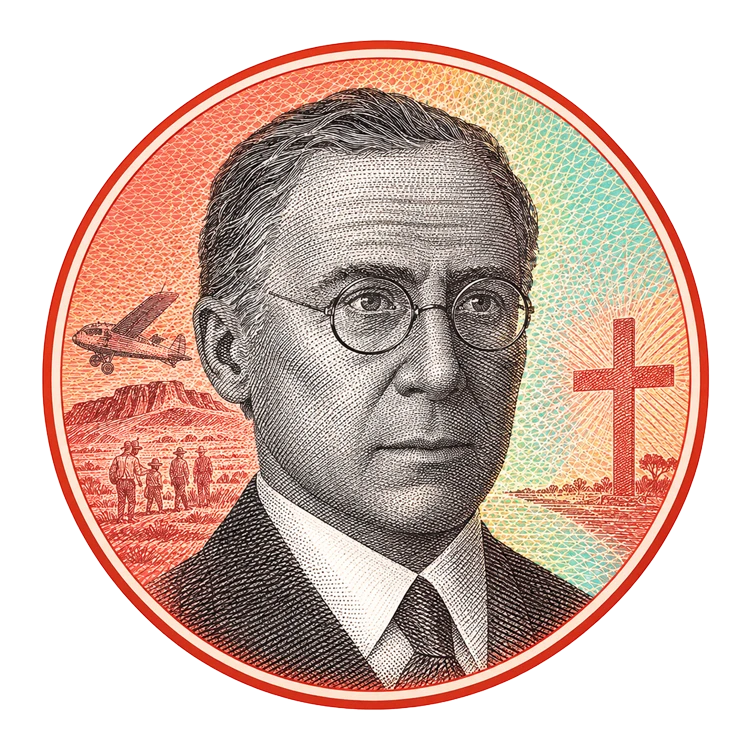
Rear Side: Reverend John Flynn
Reverend John Flynn (1880–1951) was a Presbyterian minister who saw the extreme hardships faced by people living in the remote Australian outback. Medical care was almost non-existent in these isolated areas. To fix this, Flynn founded the Australian Inland Mission and later established the Royal Flying Doctor Service in 1928, creating the world’s first air ambulance. The $20 note displays Flynn alongside a De Havilland aircraft and the pedal-powered radio he helped develop, which allowed remote farmers to call for medical help.
The $50 Banknote: David Unaipon and Edith Cowan
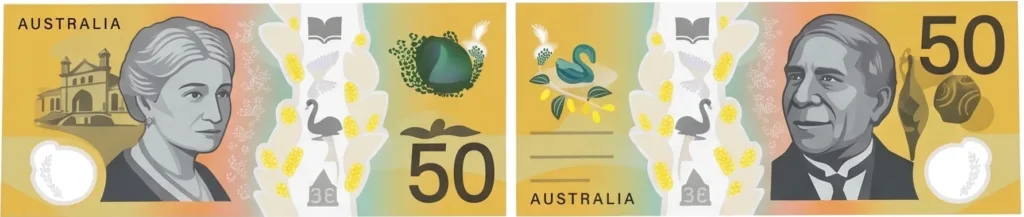
The $50 note is yellow, earning it the affectionate slang name “pineapple” among Australians. Upgraded in 2018, it features a flying Black Swan and the Acacia humifusa wattle. The people on this bill broke major barriers for Indigenous Australians and women.
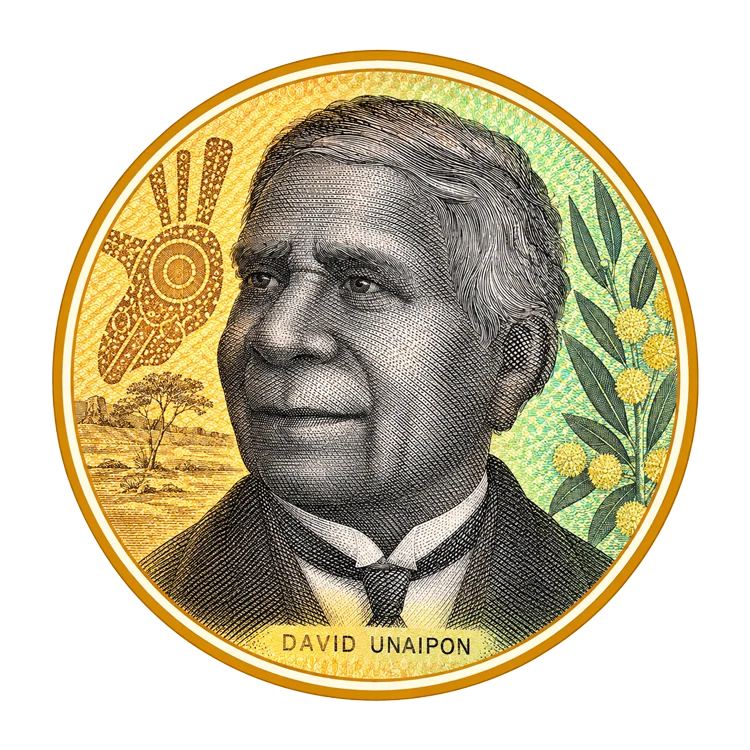
Front Side: David Unaipon
David Unaipon (1872–1967) was a Ngarrindjeri man, inventor, preacher, and author. He is highly regarded as the first published Aboriginal Australian writer, having written “Legendary Tales of the Australian Aborigines.” He was also a prolific inventor who took out 19 provisional patents during his life. His most famous invention was a modified sheep-shearing handpiece that changed the wool industry. You can see diagrams of his shearing invention and the church where he preached in the background of his portrait.
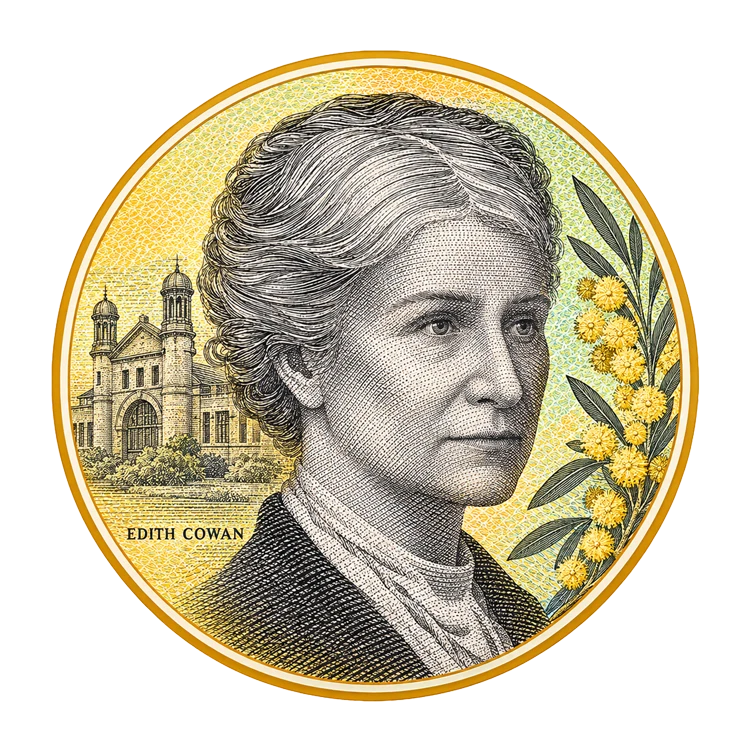
Rear Side: Edith Cowan
Edith Cowan (1861–1932) made history as the first woman elected to any Australian parliament, winning a seat in the Western Australian Legislative Assembly in 1921. Her childhood was marked by tragedy: her mother died in childbirth, and her father was later executed for the murder of his second wife. These early experiences drove Cowan to fight aggressively for the rights of women, children, and families. She pushed for better public education, maternal health services, and the rights of women to practice law. The $50 note shows her portrait alongside the King Edward Memorial Hospital for Women, an institution she helped establish.
The $100 Banknote: Dame Nellie Melba and Sir John Monash
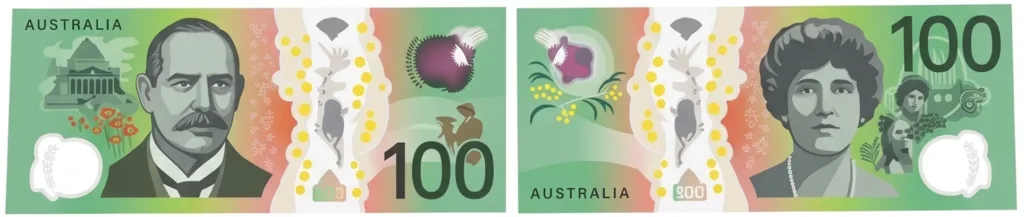
The $100 note is green and represents the highest denomination in Australian currency. The redesigned version entered circulation in 2020 and includes a flying Australian Masked Owl and the Golden Wattle, Australia’s national floral emblem. The note honors a world-famous entertainer and a military mastermind.
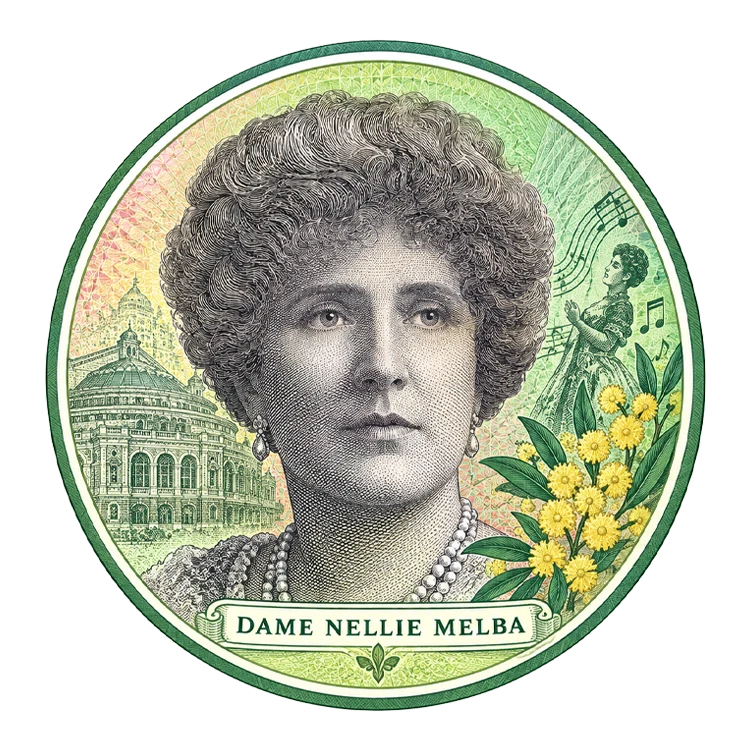
Front Side: Dame Nellie Melba
Dame Nellie Melba (1861–1931), born Helen Porter Mitchell, was an internationally famous soprano. She became the first Australian classical musician to achieve massive international fame, performing in the greatest opera houses of Europe and America. The French chef Auguste Escoffier even invented the famous dessert Peach Melba and the crisp Melba toast in her honor. The $100 banknote includes a portrait of her, an image of her in costume playing Rosina in the “Barber of Seville,” and a replica of her signature.
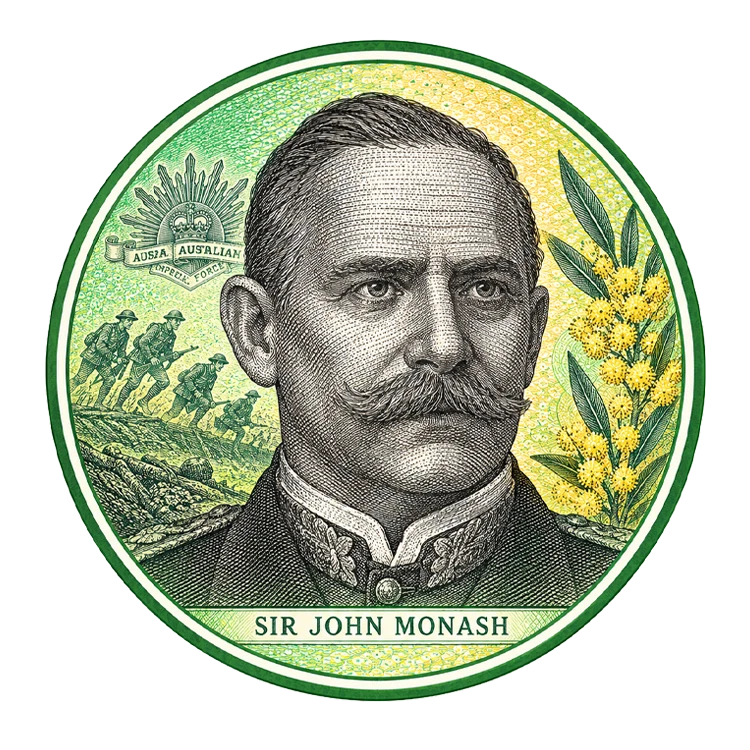
Rear Side: Sir John Monash
Sir John Monash (1865–1931) was a highly skilled civil engineer and one of Australia’s greatest military commanders. During World War I, he commanded the Australian Corps on the Western Front, leading them through a series of highly successful campaigns in 1918. After the war, Monash returned to his engineering roots, managing the repatriation of soldiers and becoming the chairman of the State Electricity Commission of Victoria. The note shows him in his military uniform alongside an image of the Shrine of Remembrance in Melbourne, a war memorial he helped build.
Why Australia Uses Polymer Banknotes
When looking at who is on the Australian dollar, you also have to look at what the money is made of. In 1988, Australia became the first country in the world to issue a polymer banknote. The Reserve Bank of Australia teamed up with the Commonwealth Scientific and Industrial Research Organisation (CSIRO) to develop the plastic material as a way to combat counterfeiting.
Paper notes wore out quickly and were easy to fake. Polymer notes, on the other hand, last up to three times longer than paper money. They are waterproof, difficult to tear, and allow for advanced security features like clear windows and holographic images. Today, the technology developed in Australia is used by dozens of countries around the world, including Canada.
The latest series of banknotes, released between 2016 and 2020, added a clear window that runs from the top to the bottom of the bill. It also introduced tactile features—small raised bumps on the edges of the notes—so visually impaired people can tell the difference between a $5, $10, $20, $50, and $100 bill just by touching it.
Exchanging AUD to CAD and CAD to AUD in Toronto
Understanding the faces on AUD bills makes handling the currency a lot more interesting. Whether you are holding Banjo Paterson on the $10 note or Mary Reibey on the $20, you are looking at small pieces of Australian history.
If you are planning a trip down under or returning home to Canada with leftover Australian cash, SILKROAD Currency Exchange provides fast, secure currency exchange. Located in Toronto, we offer competitive rates when you need to convert CAD to AUD or AUD to CAD. You can check our live rates online or visit us directly to get your travel money sorted without paying hidden banking fees.