

Do you know Who is on Canadian Dollar Banknotes?

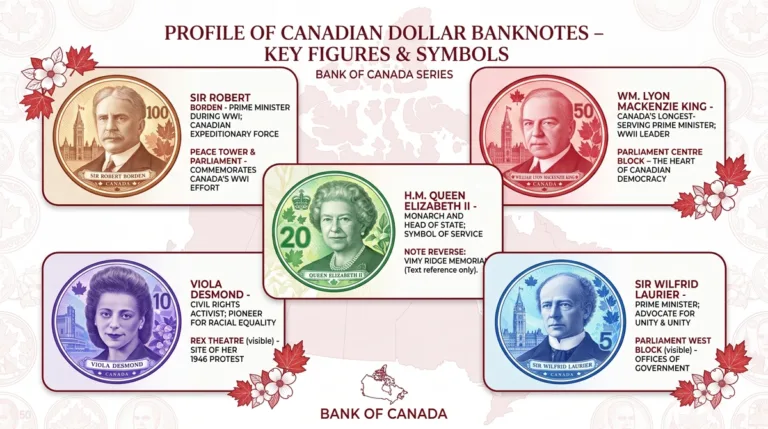
People often ask who is on Canadian dollar bills. Whether you are traveling to Canada, working in finance, or visiting Silk Road Currency Exchange in Toronto to trade foreign currencies, you handle these polymer notes daily. The portraits on Canada dollar belong to prime ministers, royalty, and a civil rights leader. The Bank of Canada selects these individuals based on their historical roles. Here is exactly Who is on Canadian Dollar Banknotes each denomination today.
The Five-Dollar Bill: Sir Wilfrid Laurier
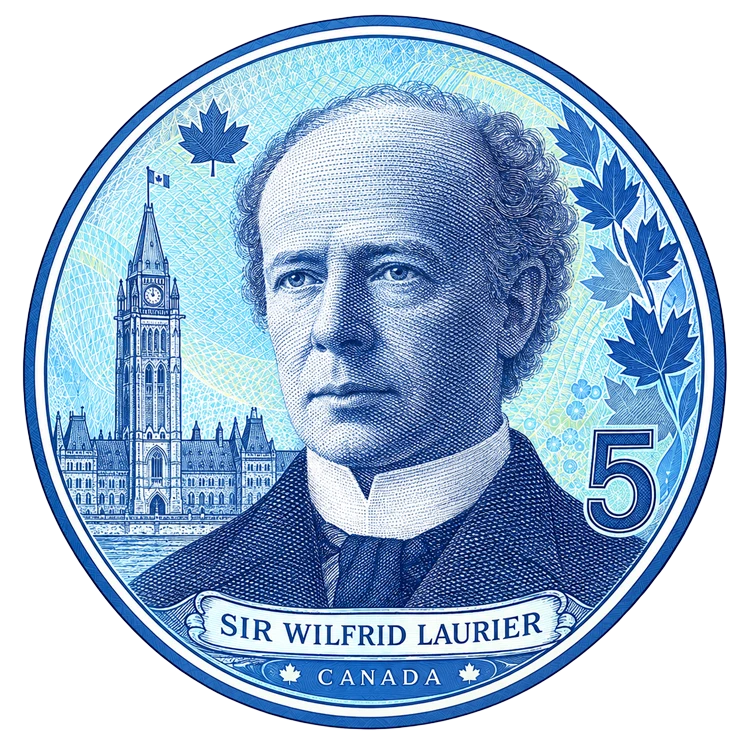
Sir Wilfrid Laurier appears on the blue five-dollar bill. He was Canada’s seventh prime minister. He was the first francophone to hold the office. He served from 1896 to 1911. During his time in office, Canada experienced massive immigration and expansion in the West. His government oversaw the addition of Alberta and Saskatchewan to the Confederation in 1905.
The back of the current polymer five-dollar bill shows the Canadarm2 and Dextre. These are robotic arms used on the International Space Station. The Bank of Canada chose this imagery to represent Canadian contributions to space engineering. The design includes an astronaut floating in space and the word “Canada” printed in large lettering.
The Ten-Dollar Bill: Viola Desmond
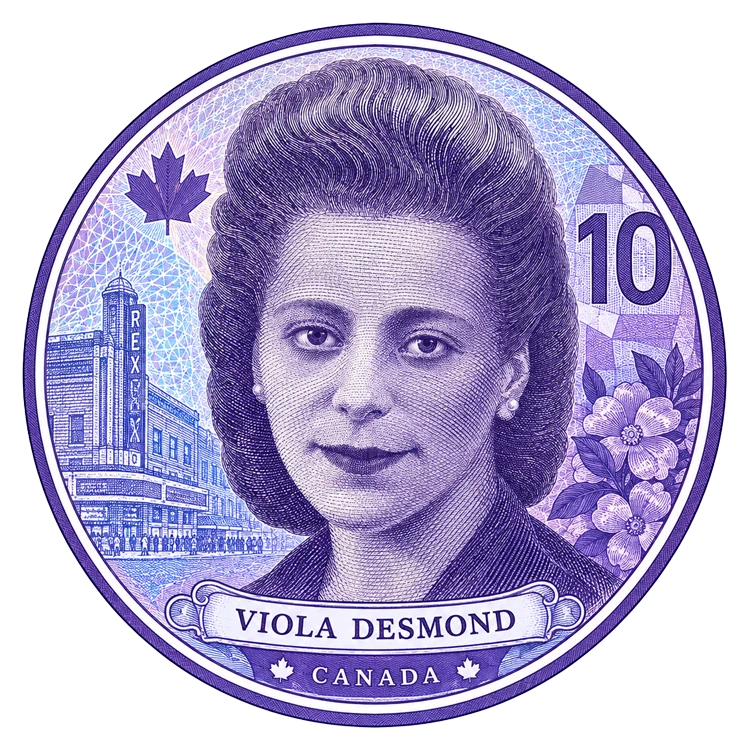
If you want to know who is on CAD, the vertical purple ten-dollar bill is a unique case. It features Viola Desmond. She is the first Canadian woman to appear on a regular circulation banknote. The Bank of Canada shifted the orientation of the bill specifically for her portrait, making it the first vertical banknote in Canadian history.
In 1946, Desmond refused to leave a whites-only section of a movie theatre in New Glasgow, Nova Scotia. Police arrested her for tax evasion over a one-cent difference in ticket prices between the lower floor and the balcony. Her court case became one of the first known legal challenges against racial segregation in Canada. She replaced Sir John A. Macdonald, Canada’s first prime minister, on the ten-dollar denomination.
The back of this bill shows the Canadian Museum for Human Rights in Winnipeg. It also features an eagle feather, which represents the ongoing journey toward recognizing the rights of Indigenous peoples in Canada.
The Twenty-Dollar Bill: Queen Elizabeth II
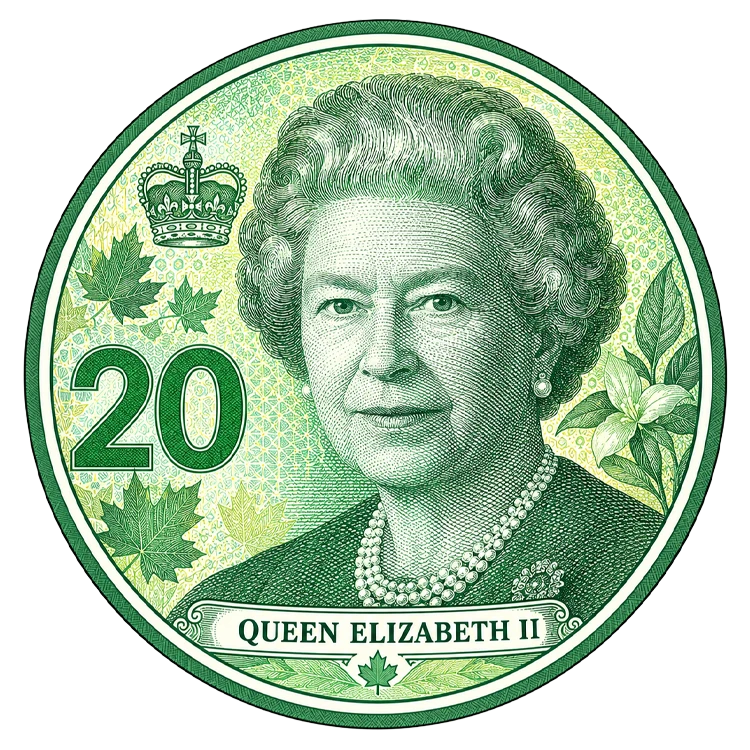
Queen Elizabeth II appears on the green twenty-dollar bill. She has been a fixture on Canadian money since 1935, when she appeared on the $20 bill as an eight-year-old princess. Because Canada is a constitutional monarchy, the reigning monarch traditionally appears on the currency. Following her death in 2022, the Bank of Canada announced that King Charles III will eventually replace her on the twenty-dollar bill. The current green polymer notes will remain in circulation for years.
The twenty-dollar bill is the most common denomination in Canada. ATMs across the country dispense $20 bills by default. The back of the bill features the Canadian National Vimy Memorial in France. This monument honors the Canadian Expeditionary Force members killed during the First World War. Beside the memorial, the bill displays red poppies.
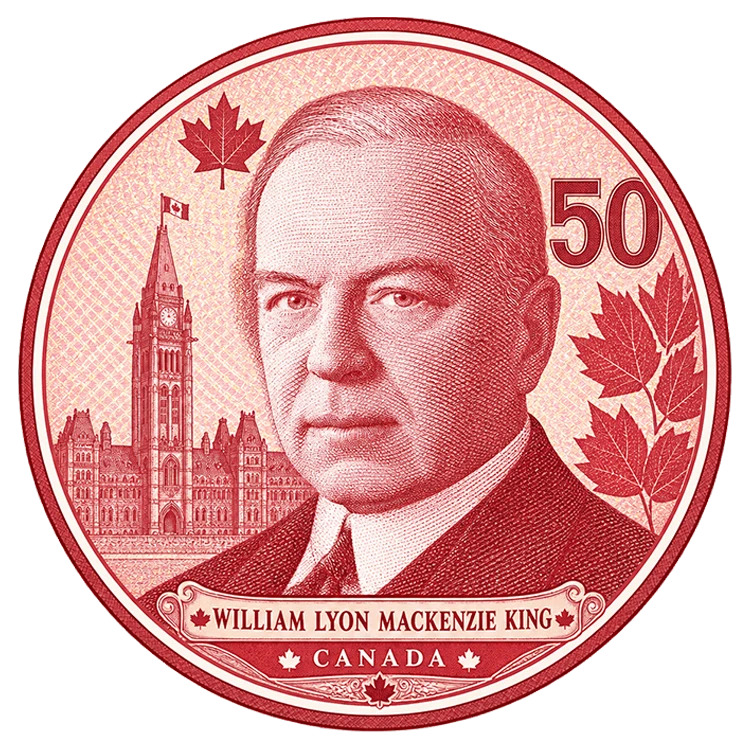
The Fifty-Dollar Bill: William Lyon Mackenzie King
The red fifty-dollar bill features William Lyon Mackenzie King. He served as Canada’s prime minister for 22 years across three separate terms. He led the country through the Second World War and introduced unemployment insurance. He is the longest-serving prime minister in Canadian history.
The reverse side of the fifty-dollar bill displays the CCGS Amundsen. This is a Canadian Coast Guard icebreaker ship used for Arctic research. The background imagery includes a map of Canada’s northern regions and the word “Arctic” written in Inuktitut. This bill is less common in daily circulation but is heavily used for large cash transactions and foreign currency exchanges.
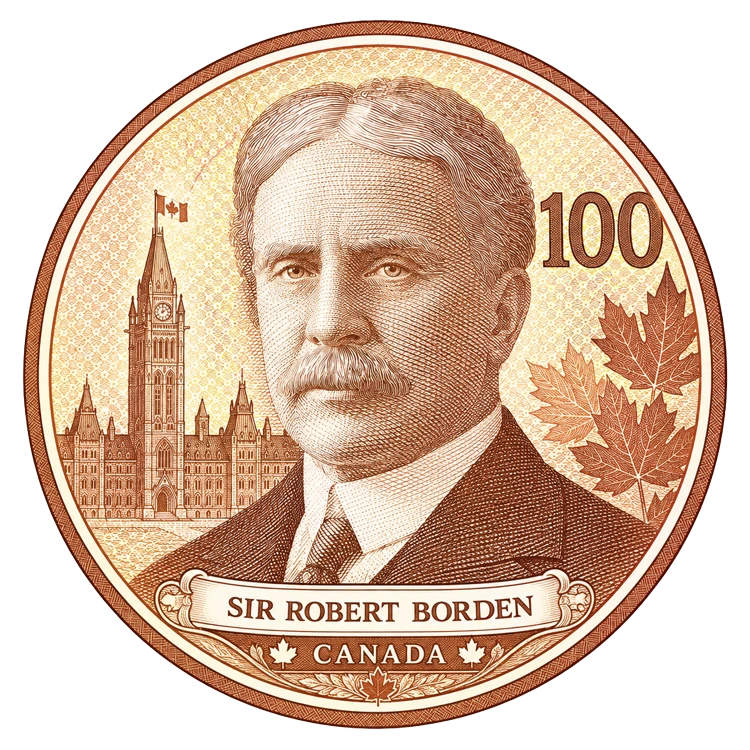
The One Hundred-Dollar Bill: Sir Robert Borden
Sir Robert Borden is on the brown one hundred-dollar bill. He was Canada’s eighth prime minister, serving from 1911 to 1920. Borden led Canada through the First World War. His government introduced the War Tax Act in 1915. This was the first federal income tax in Canadian history. He also passed the Wartime Elections Act, which gave voting rights to some women for the first time in federal elections.
The back of the $100 bill focuses on medical innovation. It shows a researcher using a microscope and a vial of insulin. Canadian scientists Frederick Banting and Charles Best discovered insulin in 1921. The design also features an electrocardiogram track to represent heart health research. The one hundred-dollar bill is the highest denomination currently printed by the Bank of Canada.
The Switch to Polymer Banknotes
To understand the faces on Canadian dollar bills, you also have to look at the material they are printed on. The Bank of Canada began replacing cotton-paper bills with polymer in 2011. The Frontier Series was the first full set of polymer notes. Polymer lasts two to three times longer than traditional paper money. This reduces the cost of printing replacement bills for the government. The plastic material is waterproof and highly resistant to tearing.
Security features on the polymer bills include transparent windows. Inside these windows, there are metallic holographic images that change colors when you tilt the bill. You will see a small, secondary portrait of the person featured on the bill inside this transparent window. There is also raised ink on the large denomination numbers and the words “Bank of Canada.” This raised ink helps visually impaired individuals identify the bills by touch.
Design Features of the Current CAD Banknotes
Every modern Canadian bill shares specific design layouts. The front of each bill is oriented horizontally, except for the new $10 bill. The portrait sits on the left side of the horizontal bills. A large transparent window runs vertically down the right side.
Inside this window, there is a metallic portrait matching the main face on the bill. Below the metallic portrait is a metallic building representing a section of Parliament Hill in Ottawa.
- The $5 bill window contains the West Block of Parliament.
- The older $10 bill window contains the Library of Parliament.
- The $20 bill window contains the Peace Tower.
- The $50 bill window contains the Centre Block of Parliament.
- The $100 bill window contains the East Block of Parliament.
These metallic buildings are holographic. When you move the bill under a light source, the colors shift. This makes the bills extremely difficult to duplicate on standard color printers.
Previous Banknote Series in Canada
To fully answer who is on Canadian dollar bills, we must look at the older series that are still legal tender but rarely seen. The Bank of Canada periodically updates its currency to add new security features and change the thematic designs.
The Birds of Canada Series debuted in 1986. This series is famous for its colorful designs and the large birds printed on the back of each bill. The front of the bills featured many of the same portraits we see today, but the denominations included two additional bills. The two-dollar bill featured Queen Elizabeth II and the robin. The one thousand-dollar bill featured Queen Elizabeth II and the pine grosbeak. The Bank of Canada stopped printing the two-dollar bill in 1996 when it introduced the “Toonie” coin. The one thousand-dollar bill was discontinued in 2000 to deter money laundering.
The Canadian Journey Series replaced the Birds of Canada series in 2001. The portraits remained exactly the same, but the themes on the back shifted from birds to Canadian culture and history. The five-dollar bill showed children playing hockey. The ten-dollar bill showed peacekeepers. The twenty-dollar bill showed artwork by Bill Reid. The fifty-dollar bill showed the Famous Five. The one hundred-dollar bill showed historical maps. These paper bills were eventually replaced by the current polymer series.
Accessibility Features of Canadian Banknotes
The Bank of Canada designs currency so visually impaired individuals can identify the denominations easily. Every bill in the current polymer series is the exact same size. They all measure 152.4 millimeters wide and 69.85 millimeters high. Because the bills are uniform in size, the bank uses a tactile feature to differentiate them.
In the top corner of each bill, there are groups of raised dots. These are a proprietary system developed by the Bank of Canada in consultation with visually impaired Canadians. The $5 bill has one group of six dots. The $10 bill has two groups of six dots. The $20 bill has three groups of six dots. The $50 bill has four groups of six dots. The $100 bill has two groups of six dots separated by a wide flat space.
The Bank of Canada also provides a free electronic banknote reader to visually impaired Canadians. This small device speaks the denomination or emits a specific tone when a bill is inserted into the slot.
How the Bank of Canada Chooses the Portraits
The process of choosing who is on the Canadian dollar involves public input. When the Bank of Canada decided to redesign the ten-dollar bill, they asked Canadians to nominate an iconic woman from the country’s history. They received thousands of submissions from the public. An independent advisory council reviewed the nominations and gave a shortlist to the Minister of Finance. The Minister of Finance made the final decision to select Viola Desmond.
For future redesigns, the Bank of Canada will continue to consult the public. The next bill scheduled for a redesign is the five-dollar note. A shortlist of potential candidates has already been created. The list includes Terry Fox, an athlete and cancer research activist. It also includes Crowfoot, a Siksika Nation chief. Until the new design is finalized and printed, Sir Wilfrid Laurier will remain on the blue bill.
Counterfeit Prevention in Currency Exchange
When you exchange money at a commercial business, the tellers verify every bill. Canadian polymer bills have multiple layers of security to stop counterfeiting. The transparent window is the primary defense. Counterfeiters find it difficult to replicate the clear plastic window integrated seamlessly into the polymer material.
Inside the frosted maple leaf on the bill, there is a hidden numbers feature. If you shine a single point source of light through the frosted leaf, you will see a circle of numbers matching the bill’s denomination. Tellers at currency exchanges use ultraviolet lights and automated cash counters to check these features in bulk.
Exchanging Canadian Dollars in Toronto
If you need to buy or sell CAD, working with a local exchange is the standard process. At Silk Road Currency Exchange in Toronto, we process Canadian dollar transactions every day. We exchange CAD with most major global currencies.
When you bring foreign currency to our Toronto office, we provide the exact current exchange rate and give you Canadian polymer bills in return. We verify all bills using commercial counting machines that check the security features mentioned above. If you are preparing to travel outside of Canada, we exchange your CAD for the currency of your destination. We keep the major global currencies in stock at our location on Yonge Street to provide immediate service.
We handle all denominations of the Canadian dollar. People often ask us for specific bills when they exchange money. For everyday purchases in Toronto, the $20 bill is the most convenient. Many small businesses do not accept $50 or $100 bills for minor purchases due to cash drawer limits. When you visit our website at silkroadex.ca or our physical office, you can request specific denominations. If you need small bills for tips or taxis, we provide $5 and $10 notes. If you are carrying a large amount of cash for business, we provide $50 and $100 bills to reduce the physical size of your currency stack. We monitor global exchange rates in real-time to provide accurate conversions between CAD and other major currencies like USD, EUR, GBP, and JPY.