
Introduction: What Was the Silk Road?
The Silk Road was not a single road, but a vast and complex network of land and maritime trade routes that connected East Asia, Central Asia, the Middle East, Africa, and Europe for over 1,500 years. This system played a crucial role in shaping the world’s economic, cultural, technological, and political development.
From silk and spices to gold, ideas, religions, and even diseases, the Silk Road was the backbone of ancient globalization. Its influence can still be seen today in modern trade routes, cultural similarities between distant regions, and even contemporary financial systems.
This article explores the ages, the map, countries, currencies, and the lasting impact of this legendary trade network.
The Origin
Why Was It Called the Silk Road?
The term “Silk Road” comes from the lucrative silk trade originating in ancient China. Chinese silk was one of the most sought-after luxury goods in the ancient world, prized for its softness, beauty, and rarity.
However, silk was only one of many commodities traded. It also transported:
- Spices
- Tea
- Jade
- Precious metals
- Textiles
- Ceramics
- Horses
- Glassware
Despite its name, This Road was a global exchange system, not merely a silk route.
Silk Road Ages: Historical Periods
Understanding the ages helps explain how this trade network evolved over time.
1. Early Formation (2nd Century BCE – 3rd Century CE)
Officially emerged during the Han Dynasty of China (206 BCE – 220 CE).
- Emperor Wu of Han sought alliances and trade connections with Central Asia.
- Diplomat Zhang Qian explored western territories, opening routes toward Persia and the Mediterranean.
- Trade flourished between China, India, Persia, and Rome.
This period marked the foundation of the Silk Road trade routes.
2. Golden Age (4th – 8th Century CE)
The Silk Road reached its peak during this era.
Key factors:
- Stable empires like the Tang Dynasty, Sassanian Empire, and Byzantine Empire
- Growth of caravan cities such as Samarkand, Bukhara, and Merv
- Increased demand for luxury goods
Cultural and religious exchange intensified, spreading Buddhism, Christianity, Zoroastrianism, and early Islam.
3. Islamic Expansion and Trade Flourishing (8th – 13th Century)
Islamic Caliphates played a major role in its development.
- Baghdad became a global center of trade and science.
- Islamic merchants dominated the commerce.
- Innovations in banking, contracts, and Silk Road currencies improved long-distance trade.
4. Mongol Era (13th – 14th Century)
Under Genghis Khan and the Mongol Empire, the Silk Road experienced unprecedented security.
- Known as the Pax Mongolica
- Merchants could travel safely across vast territories
- Marco Polo famously journeyed along the Silk Road during this period
This era marked the last great flourishing of The Silk Road.
5. Decline of the Silk Road (15th Century)
The Silk Road declined due to:
- Rise of maritime trade routes
- European naval exploration
- Political fragmentation in Central Asia
Although land routes weakened, the Silk Road’s legacy endured.
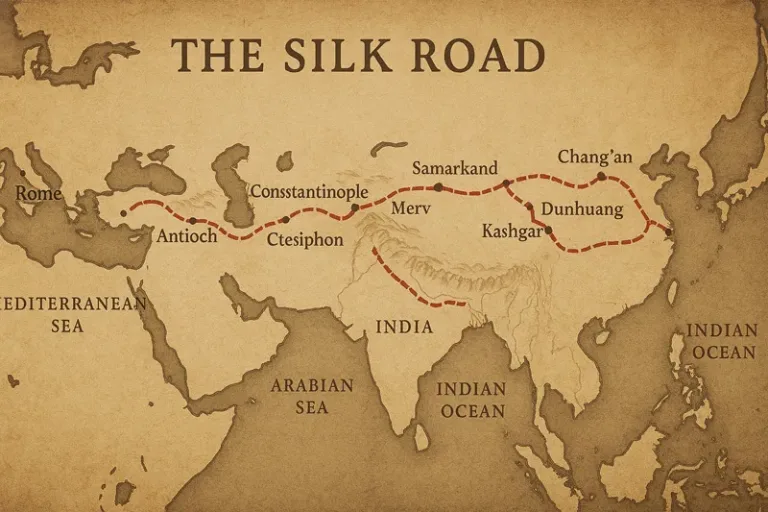
Silk Road Map: Understanding the Trade Routes
A Silk Road map reveals a complex web rather than a single path.
Major Land Routes
- Northern Route
- China → Central Asia → Black Sea → Europe
- Southern Route
- China → India → Persia → Middle East
- Central Route
- China → Samarkand → Persia → Mediterranean
Maritime Silk Road
The Maritime Silk Road connected:
- China
- Southeast Asia
- India
- Arabian Peninsula
- East Africa
- Southern Europe
This sea-based route became increasingly important in later Silk Road ages.
Countries: Regions and Civilizations Involved
The Silk Road connected dozens of civilizations. Key Silk Road countries included:
East Asia
- China (Han, Tang, Song Dynasties)
- Korea
- Japan (indirectly via maritime routes)
Central Asia
- Uzbekistan
- Kazakhstan
- Turkmenistan
- Kyrgyzstan
- Tajikistan
South Asia
- India
- Pakistan
- Sri Lanka
Middle East
- Iran (Persia)
- Iraq
- Syria
- Turkey
Europe
- Italy (Venice, Genoa)
- Greece
- Roman and Byzantine territories
Africa
- Egypt
- Ethiopia
- East African coastal states
Each region contributed goods, knowledge, and culture to the Silk Road system.
Currencies and Trade Systems
Barter and Commodity Money
In early Silk Road trade, merchants relied on:
- Barter systems
- Gold and silver
- Silk as a form of currency
Silk itself functioned as high-value commodity money, especially in Central Asia.
Coinage Along the Silk Road
Different empires introduced standardized coins:
- Chinese bronze coins with square holes
- Persian silver drachms
- Roman gold aurei
- Islamic dinars and dirhams
These Silk Road currencies enabled smoother trade between distant regions.
Banking and Financial Innovation
Islamic traders introduced:
- Bills of exchange
- Letters of credit
- Early banking institutions
These systems reduced the risk of transporting physical wealth over long distances.
Goods: What Was Traded?
From China
- Silk
- Porcelain
- Tea
- Paper
- Gunpowder (later period)
From Central Asia
- Horses
- Furs
- Precious stones
From India
- Spices
- Cotton textiles
- Ivory
From the Middle East
- Glassware
- Perfumes
- Carpets
From Europe
- Wine
- Olive oil
- Metal goods
Cultural Exchange
The Silk Road was a cultural superhighway.
Spread of Religions
- Buddhism traveled from India to China
- Islam spread across Central Asia
- Christianity reached as far as China
Exchange of Knowledge
- Mathematics
- Astronomy
- Medicine
- Architecture
Art and Language
- Hybrid art styles
- Loanwords between languages
- Shared motifs in textiles and ceramics
Technology Transfer Along the Silk Road
Some of the world’s most important inventions traveled via this Road:
- Paper (China → Middle East → Europe)
- Printing techniques
- Compass technology
- Agricultural methods
These transfers helped shape the modern world.
The Silk Road and Globalization
The Silk Road was the first true system of global trade.
Key features:
- Long-distance supply chains
- Multicultural merchants
- Cross-border currencies
- Diplomatic relations
Many modern trade principles originated on the Silk Road.
Diseases and the Dark Side
Not all exchanges were positive.
- The Black Death spread along Silk Road routes
- Epidemics moved faster due to trade networks
This highlighted the risks of early globalization.
Legacy in the Modern World
Economic Influence
- Inspired modern trade corridors
- Influenced financial systems
Cultural Legacy
- Shared cuisines
- Architectural similarities
- Religious diversity
Modern Revival
China’s Belt and Road Initiative is often described as a modern revival of the Silk Road.
The Silk Road in Modern Culture and Tourism
Today, the Silk Road is celebrated through:
- Museums
- UNESCO World Heritage sites
- Tourism routes across Silk Road countries
- Educational programs and documentaries
Conclusion: Why the Silk Road Still Matters
The Silk Road was more than a trade route—it was the foundation of interconnected civilizations. Through the exchange of goods, ideas, currencies, and cultures, The Silk Road shaped human history in ways that continue to influence the modern world.
Understanding the Silk Road ages, Silk Road map, Silk Road countries, and Silk Road currencies gives us insight into how early globalization worked—and why cooperation across borders has always been essential for progress.
FAQ
What was the Silk Road?
The Silk Road was a vast network of land and maritime trade routes that connected Asia, Europe, Africa, and the Middle East for over 1,500 years.
Why was the Silk Road important?
The Silk Road enabled global trade, cultural exchange, religious spread, and technological innovation between ancient civilizations.
Which countries were part of the Silk Road?
Silk Road countries included China, India, Iran, Uzbekistan, Turkey, Italy, Egypt, and many regions across Central Asia and Europe.
What currencies were used on the Silk Road?
Silk Road currencies included Chinese bronze coins, Persian silver coins, Roman gold coins, Islamic dinars, and silk as commodity money.
What caused the decline of the Silk Road?
The Silk Road declined due to the rise of maritime trade, European exploration, political instability, and the fall of key empires.